If you’ve ever wondered why, in the long run, casinos always seem to win, the answer lies in a mathematical principle known as the “house edge.” Whether you’re a casual gambler or just curious about how casinos make money, understanding house edge is essential to grasping how games are designed, why some games are more favorable to players than others, and how your chances of winning are influenced every time you place a bet. In this article, we’ll unravel the concept of house edge in casino games, break down its impact across different games, and provide real-world examples to illustrate how it all works.
What Is House Edge and Why Does It Exist?
The house edge is the built-in advantage that casinos have over players in every game they offer. Expressed as a percentage, it represents the average gross profit the casino expects to make from each game over time. For example, if a game has a house edge of 5%, the casino expects to keep $5 for every $100 wagered by players in the long run.
The existence of the house edge is not arbitrary. It is carefully calculated and programmed into the rules of each game. Casinos are businesses with substantial operating costs—staff salaries, property maintenance, technology, and, in the case of online casinos, cybersecurity. The house edge ensures that, even after paying out winnings, the casino remains profitable.
.png) Some key facts about house edge:
- The house edge is not a “fee” or “commission”; it’s the mathematical advantage embedded in the game’s design.
- It does not guarantee the casino will win every time—players can still win in the short term—but it does ensure the casino profits over thousands or millions of bets.
- House edge varies significantly between games and even between different versions or rulesets of the same game.
Some key facts about house edge:
- The house edge is not a “fee” or “commission”; it’s the mathematical advantage embedded in the game’s design.
- It does not guarantee the casino will win every time—players can still win in the short term—but it does ensure the casino profits over thousands or millions of bets.
- House edge varies significantly between games and even between different versions or rulesets of the same game.
How House Edge Is Calculated
House edge is determined by comparing the true odds of an outcome with the payout odds offered by the casino. Let’s take an example from roulette, one of the world’s most popular casino games.
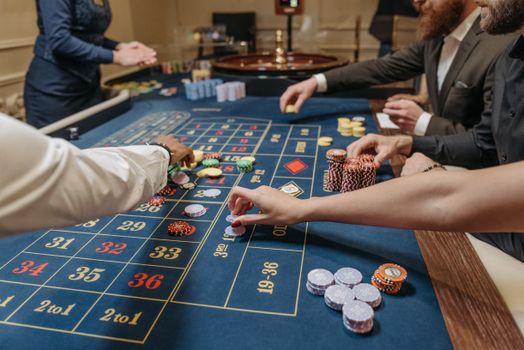
In American roulette, there are 38 pockets (numbers 1–36, 0, and 00). The true odds of hitting a single number are 1 in 38 (about 2.63%). However, if you bet on a single number and win, the casino pays you at odds of 35 to 1.
Here’s how the house edge is calculated: - Probability of winning: 1/38 = 2.63% - Payout for a $1 bet: $35 (plus your $1 back) - Expected loss per $1 bet: (37/38) x $1 (you lose) + (1/38) x $35 (you win) - Average return: [(1/38) x $36] + [(37/38) x $0] = $0.947 - House edge = (1 - $0.947) x 100 = 5.26%This means that, on average, the casino will keep 5.26 cents for every dollar wagered on a single-number bet in American roulette.
House Edge Across Popular Casino Games
Different casino games offer different house edges, and even slight variations in rules can make a significant difference. Here’s a comparative overview of house edge in some of the most popular casino games:
| Game | Typical House Edge (%) | Notes |
|---|---|---|
| Blackjack | 0.5–2.0 | With optimal strategy; can be higher with poor play or unfavorable rules |
| European Roulette | 2.70 | Single zero wheel |
| American Roulette | 5.26 | Double zero wheel |
| Baccarat (Banker Bet) | 1.06 | Lowest house edge for a standard bet |
| Baccarat (Player Bet) | 1.24 | Still very favorable |
| Baccarat (Tie Bet) | 14.36 | Much higher house edge |
| Craps (Pass Line Bet) | 1.41 | One of the best bets in the casino |
| Slot Machines | 2–15 | Varies widely by machine and jurisdiction |
| Keno | 20–35 | One of the highest house edges |
As you can see, house edge varies dramatically. For example, making a “tie” bet in baccarat is far less favorable to the player than betting on the banker or player. Slot machines and keno often have the highest house edges, while blackjack (when played with optimal strategy) and certain craps bets offer among the best odds.
Why Some Games Offer a Lower House Edge
Games with a lower house edge tend to have more skill or decision elements, or they are designed with fewer “catch-all” bets. For instance, blackjack’s house edge can be as low as 0.5% if you play using perfect basic strategy. This means learning the best action (hit, stand, double, split) for every possible combination of player hand and dealer upcard. However, most players deviate from basic strategy, raising the effective house edge.
Contrastingly, slot machines and keno require no skill. Their outcomes are entirely random, determined by computer algorithms (Random Number Generators, or RNGs). The house edge in these games is baked into the payout tables, with little opportunity for players to influence their chances.
A few notable facts: - In blackjack, using poor strategy can increase the house edge to 2% or more. - Some European roulette wheels offer “La Partage” or “En Prison” rules, which can lower the house edge to 1.35% on even-money bets. - In craps, taking “odds” bets behind your Pass Line bet has zero house edge, as it pays true odds.Long-Term Impact: The Law of Large Numbers
One common misconception is that the house edge applies to every individual bet. In reality, it is a long-term average—often called the “law of large numbers.” In the short term, players can and do win big, but over thousands of spins, hands, or rolls, the casino’s advantage becomes apparent.
Let’s look at a real-world example: - Suppose you’re playing American roulette with a 5.26% house edge. - You bet $10 per spin, 50 times per hour, for 5 hours: that’s $2,500 wagered. - Expected loss: $2,500 x 5.26% ≈ $131.50While you might walk away a winner after one session, repeated play will almost always trend toward this expected loss. This is why casinos can rely on steady profits over time, regardless of short-term streaks.
House Edge vs. RTP: Two Sides of the Same Coin
In the context of online slots and some table games, you may also see the term RTP, or “Return to Player.” RTP represents the percentage of all wagered money that a game will pay back to players over time. It is the complement of the house edge.
For example: - If a slot has a 96% RTP, its house edge is 100% - 96% = 4%. - The higher the RTP, the better it is for the player; the lower the house edge, the less money the casino expects to keep.Some popular online slots, such as NetEnt’s “Blood Suckers,” offer RTPs up to 98%, meaning a house edge of just 2%. Conversely, some slots have RTPs as low as 85%, giving the casino a hefty 15% edge.
Can Players Beat the House Edge?
While the house edge ensures the casino’s long-term profitability, savvy players can minimize its impact—or even overcome it in rare cases. Here’s how:
- Skill and Strategy: In games like blackjack and video poker, using optimal strategy can reduce the house edge to its minimum. In rare cases, such as card counting in blackjack, players can even tilt the odds slightly in their favor—but casinos are well aware of this and take steps to prevent it. - Choosing the Right Games: Sticking to bets with the lowest house edge (such as Pass Line in craps, or Banker in baccarat) gives players the best chance to stretch their bankroll. - Bonuses and Promotions: Online casinos often offer bonuses or free spins, which can help offset the house edge if used wisely, but always read the terms and conditions. - Bankroll Management: While this doesn’t change the house edge, managing your bets and knowing when to stop can prevent devastating losses.However, no amount of skill or strategy will change the fundamental math of games like roulette, slot machines, or keno—here, luck is the only factor.
Final Thoughts on House Edge in Casino Games
Understanding house edge is crucial for anyone who enjoys casino games, whether you play for fun or hope to walk away a winner. Knowing which games offer fairer odds, how the edge is calculated, and how it impacts your wallet in the long run can help you make smarter decisions, manage your expectations, and maximize your enjoyment. Remember, the house edge doesn’t mean you can’t win—it just means the casino will always have a slight advantage over time. Play wisely, and may the odds be ever in your favor.